> Society > Local History


From a once tranquil corner to an urban hub pulsing quick pace and blaring signals, a lot has changed in Pan bazar over the years. Yet, familiar anchors in the form of timeless landmarks- the aromatic allure of Shaikh Brothers, the bold white presence of Assam Optical Co, the welcoming letters of TRIPLEX- continue to invigorate the streets. It is the decadence of witnessing such pure wonders that elicits a sudden gasp, when one soaks in the vivacious multiplicities offered within an enchanting Pan Bazar. And then, a quite chime of curiosity draws one to its spectral underbelly, where busy pavements bear the weight of timeless artifacts.
Few steps along a similar pavement and we are exposed to the glowing presence of distinct landmarks with glimmering signboards, lighting up the street corners. As the eye trails past, a vivid red flashes by in the form of a signboard with silver engravings that spell, TRIPLEX. Attached to the sign is a single-storied shop that stands rooted amidst the clamor of urban rush, yet holding a distinct image in the minds of its beholder.
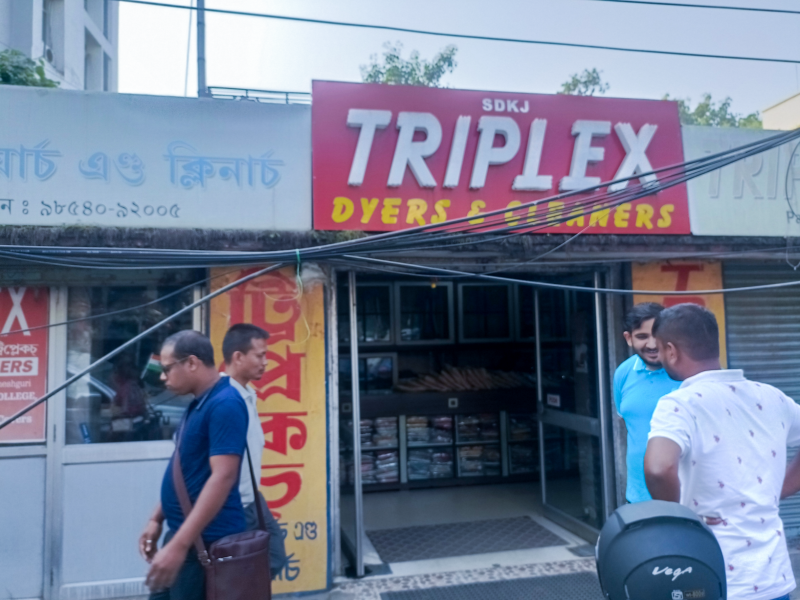
Photo - Rohit Pathak
Triplex, Guwahati’s oldest dry-cleaners, which was first established in the year 1954. The immediate gaze falls upon the store’s aluminum glass double doors, that serves as a gateway leading to a three-foot-long varnished wooden cabinet with attached tables, extended horizontally whilst anchored to the shop’s floor. The surface of the cabinet glistens with painted varnish revealing a subtle wooden weave. Carved in it are square compartments that house layers of plastic-wrapped garments, pressed, cleaned, and arranged with a precision that renders them indistinguishable from retail wears. Each piece carries a distinct glimmer; the result of careful gestures and meticulous actions refined over a significant period.
Inside, the shop hums with the cacophony of busy workers and flowing customers. The space behind the cabinet bustles with five-six eager faces, whose hands move with a familiar ease as they attend to customers’ needs. Rows of wooden showcase line Triplex’s wall, each holding garments cleaned to its immaculate form. And the white tiled floor becomes a daily gathering space for visitors with desires ranging from an immediate need to dry-clean a garment to a nostalgic urge of reminiscing the past.
To the left sits Manohar Achantani, former proprietor, who writes on a memo slip with the calm rhythm of a presence rooted in the shop’s existence. His voice carries a tone of seasoned experience and verdant warmth, as he speaks of Mukesh Achantani, his son and Triplex’s current proprietor. A figure of steady busyness and unbroken patience, who attends to each customer with quiet clarity and due diligence, defines Mukesh’s presence in the shop. When asked about the roots of Triplex’s effervescent success, he points to a heritage-driven narrative that has sustained the shop’s seventy year-long legacy.
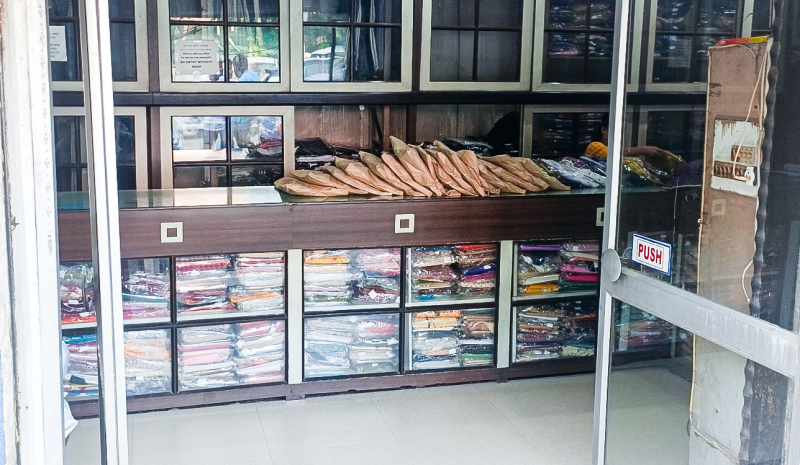
Photo- Rohit Pathak
Tracing it back to his grandfather, late Vasudev Achantani, Mukesh talks of a revolutionary vison that altered the region. First realized via a short discussion with a friend’s son educated and exposed to the concept of dry cleaning in Britain, the vision manifested in the form of purchasing machineries, which were imported via ships from Britain. Carrying the nametag Triplex on its metal surface, the name of the dry-cleaning machines imminently became the titular identity inspiring the shop’s existence.
As words of mouth became the spark lighting Triplex’s ascension, the embers were further fanned when Guwahati’s eminent personalities expressed their deep appreciation over the shop’s revolutionary presence. In fact, the shop carries a register, as Mukesh informs, which consists the names of earliest customers who visited Triplex since its advent. And amidst the list, a notable personality who frequented the shop was none other than legendary figure Radha Govinda Baruah.
Furthermore, the revolutionary spirit that Triplex carried within its identity, also emerged in the form of its sustainable practice. They were amongst the earliest establishments to consistently use brown paper wrapping for garments (dating back to a time when clothes were cleaned for a one rupee in the shop), thereby nurturing an ecosystem of reuse and environmental mindfulness, long before sustainability entered common discourse. Gradually, the shop saw a steady boom of customers, with the likes of government clerks, officers, lawyers, teachers, bankers, doctors etc., working in and around Pan Bazar. These customers wore formal clothing such as suits, coats, woolens, and traditional sarees; delicate fabrics that required professional cleaning beyond the means of home washing.
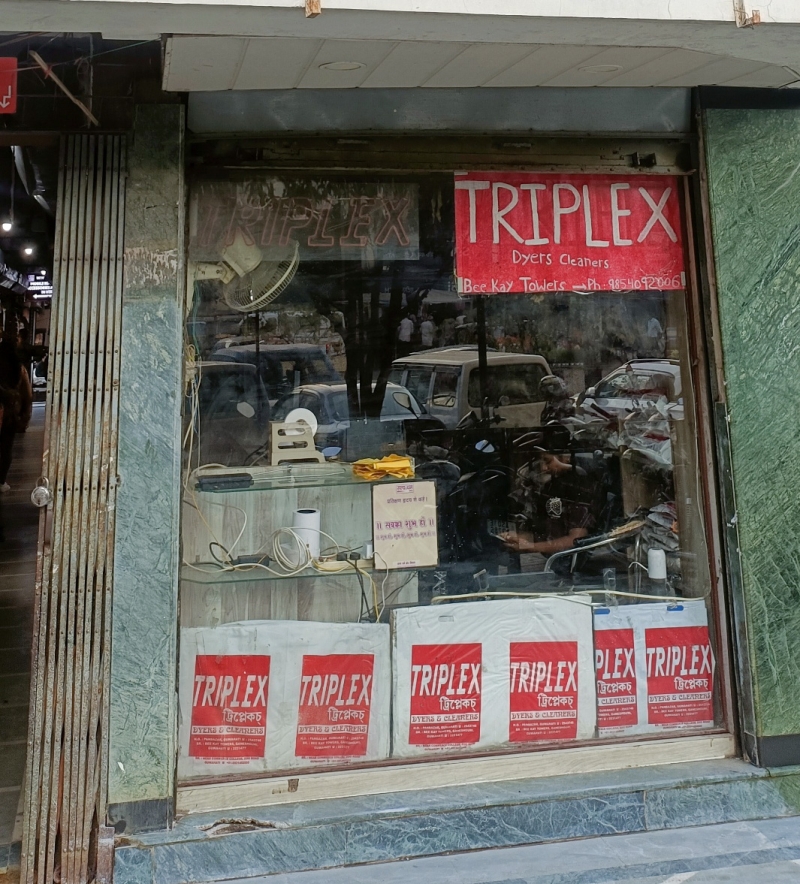
Photo - Rohit Pathak
Since then, the trajectory of Triplex’s success and proliferation has traced a steady ascent. What became as a humble establishment soon grew into the very soul of drycleaning, drawing generations of Guwahati across its doors. As its roots stretched and trust deepened, so did the numbers of customers and loyal patrons. Gradually, the momentum was carried forward as Triplex expanded into a network of branches, with shops located in Zoo Road and Dispur. Thus, Vasudev Achantani’s (or Ashababu as he was popularly known) manifested dream project ushered in a legacy defined along the motto of quality assurance and customer satisfaction. And preserving this legacy across three generation, is the Achantani’s heritage driven craft passed down to the current proprietor, who remains faithful to its predecessors’ vision.
Today, that same commitment stands at the heart of a legacy that has endured seventy years of economic upheavals and developmental change. Amidst multiple transformations, one notable shift is the growth of alternate dry-cleaning establishments across multiple corners of present-day Guwahati. Yet, Triplex continues to persist and thrive, moving headfast amidst the nuances of a present which is at a significant distance from the past. So, what allows a venture to hold its ground and flourish in a time so far removed from its humble beginnings. The answer lies in a simple expression by Mukesh- “Dry-cleaning mur etia bloodot xumai goise” (Dry-cleaning has now entered my blood).
His words reflect the reason older institutions still endure, following a generational commitment to quality, patience, and deep familiarity with the craft. Newer shops he argues, often lack a deep, practiced understanding of dry-cleaning machinery, and the patient experimentation the trade demands. This is especially evident in traditional Assamese garments like Mekhela Chador, which require a level of care beyond the means of modern establishments. Because Triplex has cleaned such garments for generations, he highlights how it alone retains the nuances, tools, and institutional capacity necessary to do the job properly.
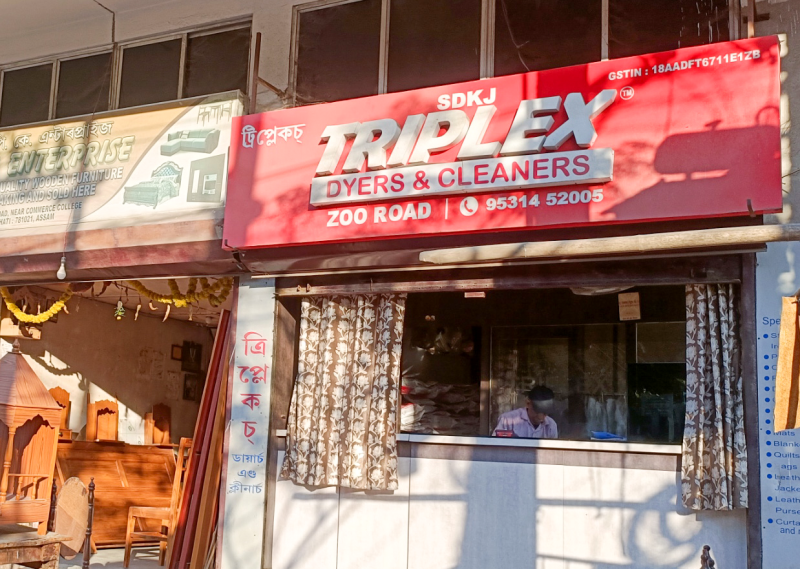
Photo - Rohit Pathak
Mukesh realises the current trend where expectations and desires are attached intensely with one’s apparel needs and how people in the current generation are highly conscious about individual specific requirements.
To meet the demands of such dynamic times, he emphasizes Triplex’s constant focus over improving its backend support system. Carrying a modern vision, where innovation coexist with the heritage-driven tradition, the improvements mainly consist of a careful introduction of new technologies within its industrial infrastructure and a continuous refinement of the inherited craft. Thus, an edge that no other shop can replicate- rooted in a generational trove of knowledge, wisdom, rote methods and dynamic resilience- underpins Triplex’s reputation as a landmark of timeless excellence, refined overtime.
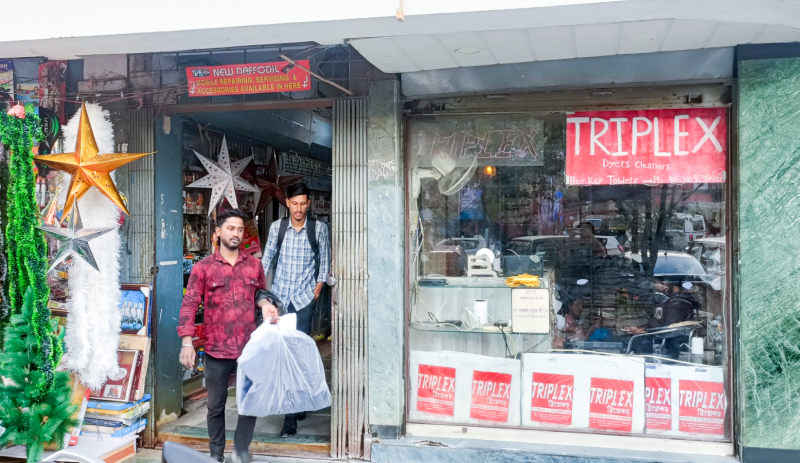
Photo - Rohit Pathak
Beyond the architectural doors and its caretaker’s vision, the strength of Triplex’s legacy can be further understood through the voices of those who have been a part of it for decades. Among its earliest patrons is veteran social activist and Padma Shri awardee, Ajoy Kumar Dutta, who, while attesting to Triplex’s unwavering legacy, recalls the shop’s amicable atmosphere from his earliest memories. He reminisces of a time when Delight Restaurant and Gauhati Dairy defined the quiet corners of Pan bazar, with Triplex soon following and bringing a new rhythm. For him, Triplex always holds “the old smell of Guwahati,” where the mind meanders along its nostalgic presence. When asked why it has survived so long, he answers simply: “Maintain kori rakhise” (They have maintained it). Consistent service, steady rates, and unwavering commitment, he says, make Triplex “if not the best, better than most.”
So, with a spectrum of virtuous elements, Triplex has become a radiant sigil drawing a loyal base of customers-old and new-whose connection and loyalty endures alongside its long-standing presence. For many, its humble space is a source of nostalgic joy- a momentary pitstop along a journey shaped by one’s aspirations. A quick halt within its tranquil bosom, where moments of recollection transpire into thoughtful conversations, Triplex’s quiet corners and amicable atmosphere light up into a statutory haven for its visitors. Regulars still repeat the old refrain, “Ebaar Triplex or pora ahu” (let me once come from Triplex), signifying an age-old expression of trust and continuity. That spirit continues to live in the habits, the memories and the quiet loyalty of those who continues to walk through its doors…and keep returning.
 Navigations
  Quick Contact
 Subscribe Us
 Quick Mail